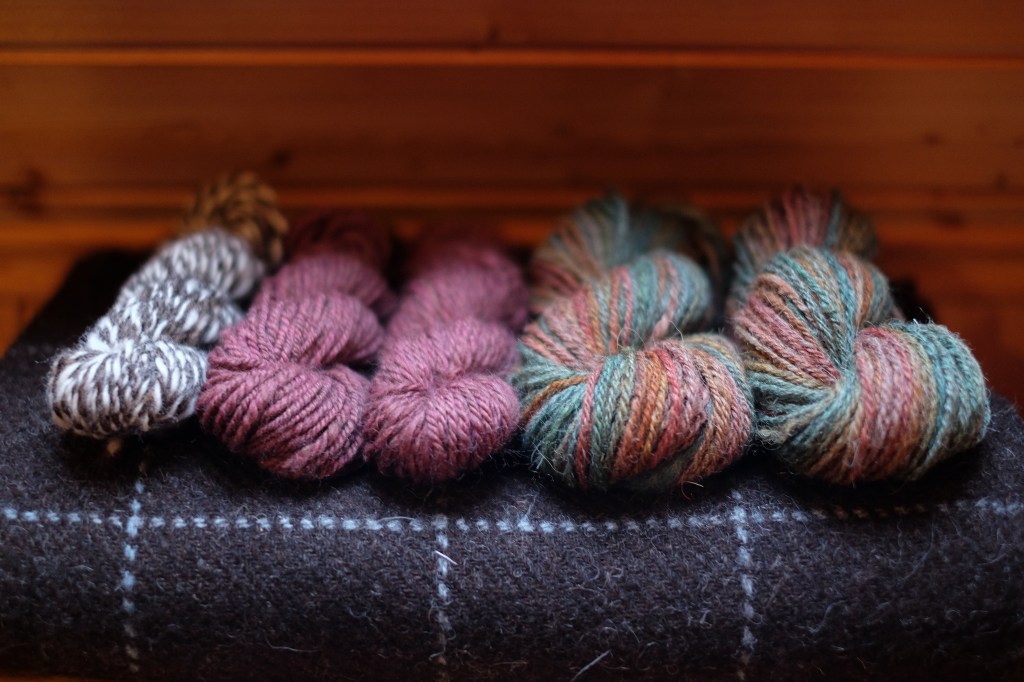
I first learned to spin yarn in 2013. I bought a drop spindle (a Louet bottom whorl) and some fiber together in a learn-to-spin kit, bought a Craftsy course, and got to work. My first few of skeins of yarn were documented on this blog (one, two, and three) and I did see rapid improvement, but my handspinning tapered off somewhere in 2014 and I more or less abandoned my spindles with some half-finished spinning projects on them. The novelty of having made yarn with my own hands was wearing off and I was becoming interested in other things. I was pretty sure I wasn’t going to become A Spinner.
Six years went by. Then in 2020, I briefly picked up a spindle again after receiving some fiber from Patricia of Knitography just before everything shut down in March 2020. It was roving made up of Norwegian wool: half grå trønder (naturally grey/brown) and half rygja (naturally white). I split the roving to spin them separately with the plan to make a marled 2-ply, but again, after getting started on the project I ended up setting it aside as things picked up with my PhD work.
But last autumn I was determined to pick it up and finish it. I’d been feeling inspired by my friend Marina’s beautiful spinning (not to mention the beautiful knitting and weaving projects she creates with her handspun yarns), and Marina was actually here in Norway when I received the fiber, so it felt a bit full circle. And in September 2023, I did manage to finish it!


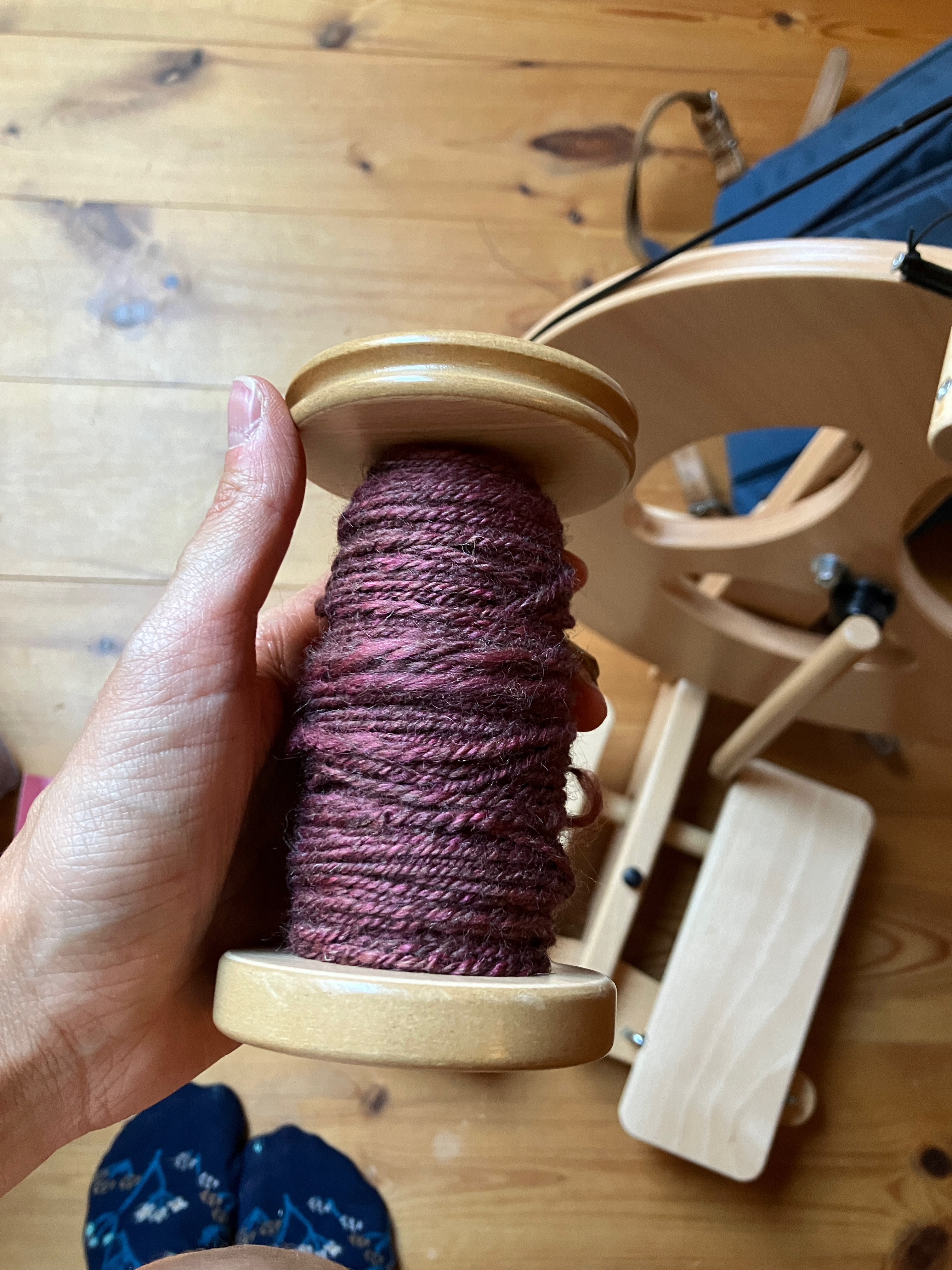
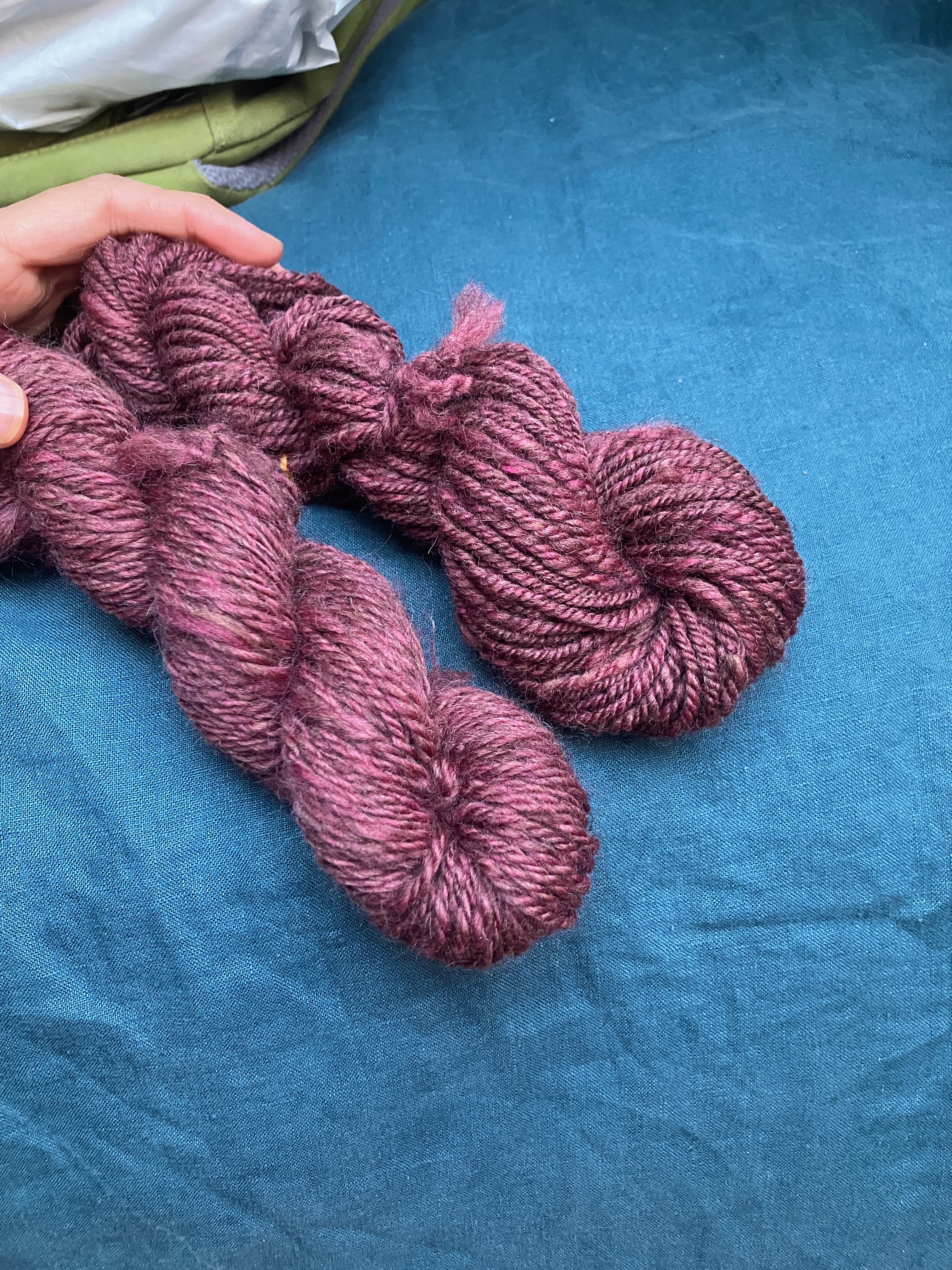
I was inspired to continue spinning, so after this I ordered some wool tops from John Arbon Textiles. Incredibly enough, this was my first dyed fiber – I don’t think I intentionally started out with undyed wool, but it does tend to be cheaper, so perhaps that’s why. But John Arbon’s colors are gorgeous. I started spinning up some Harvest Hues wool top in the Rosebay colorway. It took me a long time to get through the 100 g, as I just picked it up and spun a little bit here and there. Last winter and spring was the final push on finishing my dissertation, so there wasn’t a great deal of time for creative pursuits. But by the time I finished spinning the singles in August, I had ordered a spinning wheel. I chain plied the yarn on the wheel (my first time chain plying) and really enjoyed it. (I had a snafu with my ball winder when preparing the second single for plying, which I think is why the amount of twist came out so different between the skeins, but everything is a learning experience at this stage.)

When I realized that chain plying would allow me to maintain color shifts throughout a handspun yarn without barber poling/marling, I decided it was time to try some hand-dyed fiber. Enter Marina’s Skua Blend.

This colorway was called Panther Chameleon, but all of Marina’s fiber colorways are one-offs so it’s no longer available. The teal and orange is one of my favorite color combinations ever, so I knew I would enjoy spinning this. But somehow I was unprepared for just how much I’d enjoy it!
I decided to split the braid down the middle and spin each half end-to-end, with the goal of ending up with two matching-ish skeins that should have similar color shifts throughout. Once again, I decided to spin the singles on a spindle and then use the wheel to chain ply (I have been practicing drafting on the wheel, but my drafting skills aren’t where I wanted them to be yet for this project and I didn’t want to wait to spin it up). Having now finished both skeins, I have to say I’m thrilled with the result.


Marina’s Skua blend is truly lovely to spin, and I enjoyed watching the color changes so much that sometimes it was hard to put down. In the end, the specs for each skein are quite similar, so there really is a good chance that the color shifts will almost match when knitted up as a pair of something. I’m dying to cast on, I just have to decide what the pair of something will be first. The first skein came out at approximately 90 yards (82 m) and 51 g, while the second is approximately 93 yards (85 m) and 48 g. It’s about 183 yards (167 m) of a DK weight, altogether.
So I guess I really am A Spinner now. It only took about 10 years. I have more of Marina’s Skua blend ready to go, but I’d also like to pick up some more local fiber, so I’m eyeing what’s on offer from local-to-me Selbu Spinneri. I’m looking forward to continuing to practice drafting on my wheel, as well, so that I can have a go at a yarn spun entirely on the wheel. And I’m especially looking forward to seeing how some of these knit up.


 Paper Tiger
Leave a comment