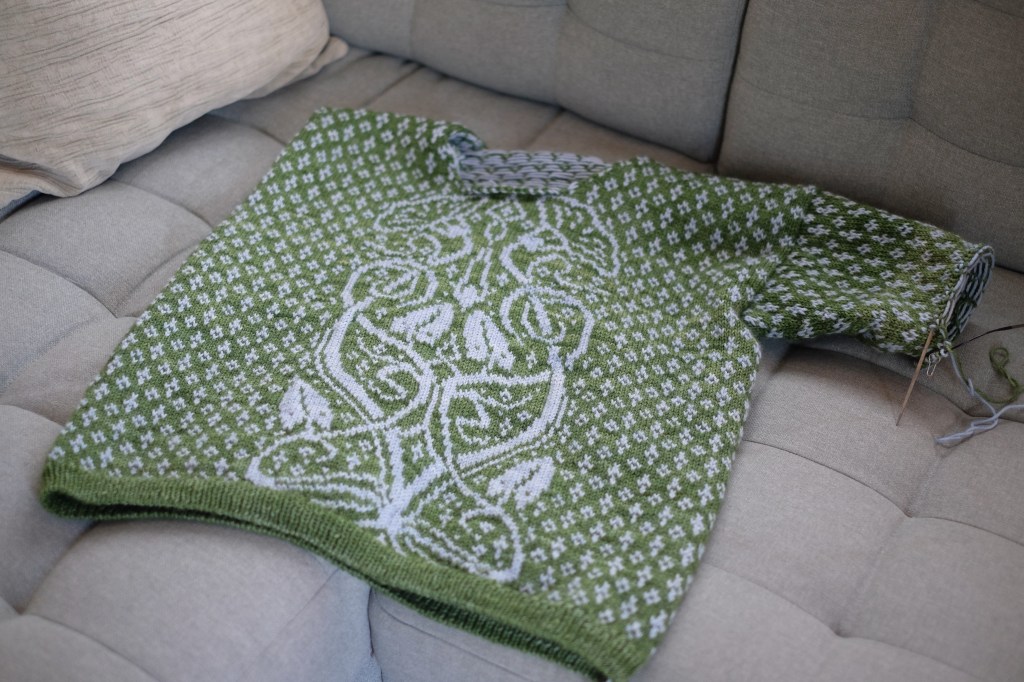
It’s been awhile since I’ve shared progress on my many WIPs, and quite a few of them have yet to feature on this blog. While I’ve been working a little bit on some older WIPs, I’ve also started several new projects in the past couple of months (a decision I am only slightly regretting). So here’s a look at some of what I’ve been working on.
First up, I’ll share the one that’s the most fun at the moment.
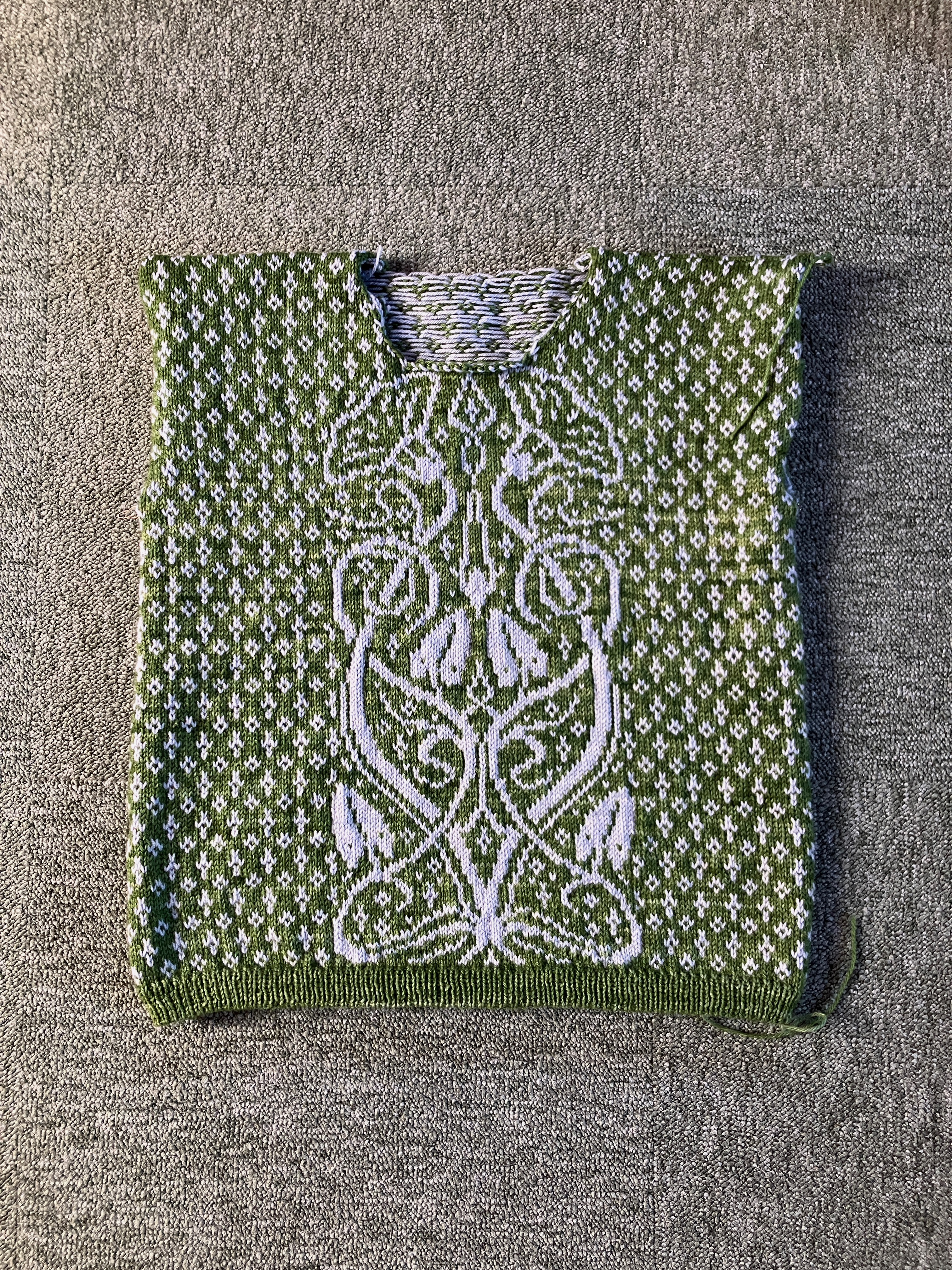
This is Marina Skua‘s Hedgebind pullover, which I began during Marina’s Out of the Dark Makealong (which runs from the first of January through to the Spring equinox). While I didn’t finish this during the makealong, I did manage to knit almost the entirety of the body, which is pretty good progress for an allover colorwork pullover. I set this aside for a little while after finishing the body, but when I had my sewing machine out for some other projects in May, I finally reinforced and cut the steeks (the pattern uses steeks for the armholes as well as the neck opening). I’m using two relatively smooth worsted spun yarns for this pullover (Fabel Knitwear Elder and Annie Bakopoulos Davies), so even though they’re both non-superwash, I knew I wanted machine reinforcement. I also wanted to avoid adding more bulk, given that these are DK weight yarns, which ruled out a crochet reinforcement.
Once the steeks were cut I could knit the neckband ribbing (not pictured here, but now finished) and start picking up stitches for the first sleeve. I’m definitely not working with the same level of motivation or momentum that I was when I began this project (the central front panel was definitely the most fun part of this pattern), but I can’t wait to wear the finished sweater so that will keep me going through the sleeves.

I’ve also started a pair of mittens with some local farm yarn (Hogna Garn Liten Kvil) for the main color, and Jamieson’s Shetland Spindrift from stash for the colorwork. I knit the first mitten back in January and have yet to knit the second, but now that summer is upon us I expect it’ll be a few more months before I pick these up again and finish them. With this perfectly autumnal palette, I imagine they’ll be perfect come August, when I’m starting to crave cooler days.

The pattern is my Laurentian Mittens, designed for Montreal yarn store Espace Tricot‘s book Knits from the LYS: A collection by Espace Tricot. Some of you may remember I worked at Espace Tricot when I lived in Montreal between 2017 and 2019, and it was a real treat to contribute to Steph and Naomi’s collection a few years ago. Because I was mid-PhD when work on this book was happening, the Laurentian Mittens were one of my designs where I wrote the pattern but didn’t actually knit the sample. So when I picked up the Hogna Garn at a market last November and decided I wanted to make mittens with it, I figured it was a good opportunity to actually knit my own design (though of course I’ve thrown in some modifications, as I am wont to do). The original pattern uses two contrasting colors but I chose four, and where the original cuff only uses one contrast color, I chose to include all of mine in an ombre stripe sequence. I deliberately chose colors to try to get myself out of my standard grey-blue-green comfort zone, and I’m really pleased with the final combination.
Lastly for now, I’m working on a triangular shawl design using Selbu Spinneri Gammel Selbu, which is a yarn Selbu Spinneri developed in collaboration with Anne Bårdsgård (whose books Selbu Mittens and Selbu Patterns I have previously waxed poetic about) to match the specs of the yarns that were used in traditional Selbu knitting.

I’m using a natural (undyed) light grey along with four colorways from their fargespunnet line, which is dyed in the wool and additionally uses naturally colored wool that lends a heathery look to the final yarn. I fell in love with the fargespunnet colors and decided it was time to finally knit up a design idea I’ve had for years: a simple triangular shawl in garter stitch, but using stripes while knitting and weaving vertical yarns through after the fact in order to achieve a woven look. It’s a technique which has long been in use in knitting, but which I first encountered in the Princess Franklin Plaid Collar published in Knitty back in 2013. I knit a scarf using this technique a few years later and I absolutely love the oversized woven plaid/tartan effect.
It was probably six or seven years ago that I got the idea to use the technique on a triangular shawl, and while I’m hardly the first to design a knitted triangular shawl in a tartan pattern, I have had fun choosing my colors and coming up with the stripe sequence that will give the overall effect I’m looking for. It also looks lovely as a plain striped shawl, but the magic happens when the vertical yarns are woven through at the very end, and I’m definitely looking forward to that stage.
I have also been sewing and spinning in the past few months, but I think I will save sharing that work for another day. And I hope to finish at least one of these projects in the near future (I think I last finished a knitting project in January). I’ll be sure to share more when I do!


 Paper Tiger
Leave a comment